Prinsesstarta Font Family: A Practical Evaluation for Designers
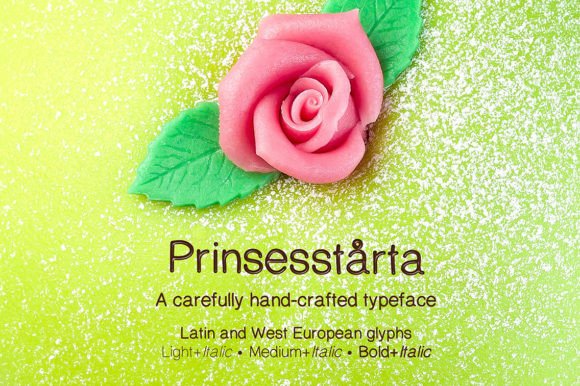
When evaluating typefaces for a project, designers often look for something that balances personality with readability, and versatility with distinctiveness. Prinsesstarta, a small but thoughtfully crafted font family by designer Shara Weber, offers exactly this kind of balance. With six weights spanning Light, Light Italic, Medium, Medium Italic, Bold, and Bold Italic, Prinsesstarta presents a compact yet capable toolkit for a range of typographic needs. This article provides a balanced assessment of the family, helping you decide whether it aligns with your design goals or whether alternatives might serve you better.
What Is Prinsesstarta?
Prinsesstarta is a typeface family designed by Shara Weber, a designer known for creating fonts that blend contemporary aesthetics with practical functionality. The family consists of six styles: three upright weights (Light, Medium, Bold) and their corresponding italic counterparts. This structure gives designers a clear hierarchy for body text, subheadings, and display use, all within a single cohesive family.
The name itself hints at a certain elegance and playfulness, but the font avoids being overly decorative. Instead, Prinsesstarta sits in a space between a neutral sans-serif and a more expressive humanist design. Its letterforms are clean and legible, with subtle details that give it character without sacrificing readability. For designers who need a typeface that works across digital and print media, Prinsesstarta offers a streamlined solution that doesn't require extensive customization or pairing with multiple families.
Why Consider Prinsesstarta?
There are several practical reasons a designer might evaluate Prinsesstarta for an upcoming project. Understanding these can help you determine if the family meets your specific needs.
Compact Yet Versatile Weight Range
With only six styles, Prinsesstarta is intentionally lean. For projects that do not require an extensive range of weights—such as a small brand identity, a personal blog, or a printed brochure—this can be an advantage. You get enough variation to create visual hierarchy without the overhead of managing dozens of files. The Light weight works well for large display text or subtle body copy, Medium serves as a reliable reading weight, and Bold provides clear emphasis. The italics add a further layer of expressive flexibility.
Designed for Readability
Legibility is a core strength of Prinsesstarta. The letter spacing is generous without being loose, and the x-height is moderate, making it comfortable to read at typical text sizes. The italic styles are slanted enough to be distinct but remain highly readable, avoiding the excessive slant that can tire the eye in longer passages. For editorial projects, newsletters, or content-heavy websites, Prinsesstarta can reduce reader fatigue while maintaining a polished appearance.
Subtle Personality
Many designers seek a typeface that stands out without overwhelming the content. Prinsesstarta achieves this through small design details—gentle curves in terminals, a slightly softened geometric structure, and balanced proportions. It feels friendly but professional, modern but not trend-driven. This makes it suitable for brands that want to appear approachable and trustworthy without resorting to overly whimsical or corporate coldness.
Benefits and Tradeoffs of Prinsesstarta
Every typeface involves tradeoffs, and Prinsesstarta is no exception. Being aware of both its strengths and limitations will help you decide whether it is the right tool for your project.
Benefits
- Consistency across styles: Because all six weights and italics are designed as a unified family, switching between them maintains visual harmony. This reduces the risk of jarring transitions when building typographic hierarchies.
- Lightweight file footprint: With only six styles, the font files are relatively few, which can improve page load times on the web and simplify font management in design software.
- Good for mixed media: Prinsesstarta works well in both print and digital contexts. Its legibility holds up on screens, while its refined details shine in printed materials like booklets and posters.
- Accessible pricing or licensing: Depending on where it is obtained, Prinsesstarta may be available at a lower cost than larger families, making it an economical choice for independent designers or small teams.
Tradeoffs and Considerations
- Limited weight range: For projects requiring extreme contrast—such as pairing a thin hairline with a heavy black weight—the six-style selection may feel restrictive. If your design relies on many intermediate weights or very bold display forms, you may need to supplement Prinsesstarta with another family.
- No condensed or extended variants: The family does not include condensed or extended widths, which can limit its use in space-constrained layouts or designs that call for dramatic horizontal stretching.
- Less well-known: Because Prinsesstarta is a smaller family from an independent designer, it has less community documentation, fewer third-party pairings, and a smaller user base compared to major foundry releases. This can make troubleshooting or finding pairing inspiration more challenging.
- Potential overlap with other fonts: Prinsesstarta occupies a similar stylistic space to many modern sans-serifs. If your project needs a truly unique or highly distinctive typeface, Prinsesstarta might not stand out enough alongside more recognizable competitors.
When Prinsesstarta Is a Strong Fit
Certain project types and design contexts align especially well with what Prinsesstarta offers. If your work falls into any of the following categories, the family is worth serious consideration.
- Small to mid-sized brand identities: For startups, local businesses, or personal brands that need a clean, friendly typeface with a touch of character, Prinsesstarta provides enough variety for logos, headings, and body copy without requiring a sprawling font library.
- Blogs and editorial layouts: The family's readability and the presence of italics make it a natural choice for long-form content. A blog about design, lifestyle, or culture could use Prinsesstarta across articles, with the Light weight for pull quotes and the Bold for section headers.
- Printed materials with limited space: Because the family is compact in both letterforms and file size, it works well in brochures, flyers, and zines where space is at a premium and you need a reliable, space-efficient typeface.
- Projects that demand a human touch: Prinsesstarta's subtle curves and approachable feel make it a good fit for nonprofits, educational materials, or community-oriented communications where warmth and clarity are priorities.
When Alternatives Might Be Worth Considering
No single typeface suits every scenario. In some situations, Prinsesstarta's limitations may lead you to explore other options. Here are a few circumstances where alternatives could be a better choice.
- Large-scale typographic systems: If your project requires multiple weights, widths, and optical sizes—such as a comprehensive design system for a global brand—a larger family like Noto Sans, Open Sans, or a foundry offering with 20+ styles will give you more flexibility and consistency across diverse use cases.
- Highly expressive or decorative designs: Prinsesstarta is restrained in its personality. For projects that need a loud, ornate, or avant-garde typeface—such as a music festival poster or a fashion lookbook—a more distinctive display font may serve you better.
- Multilingual or extended character support: Depending on the version you obtain, Prinsesstarta may have limited language coverage. If your content requires extensive diacritics, Cyrillic, or non-Latin scripts, verify the character set before committing, or consider a font with broader language support.
- Budget or licensing constraints: While Prinsesstarta is often affordable, some projects require free or open-source fonts. In that case, alternatives like Inter, Source Sans, or Work Sans provide robust feature sets at no cost and have large communities behind them.
Practical Decision-Making Insights
To determine whether Prinsesstarta aligns with your goals, consider the following practical steps:
- Audit your typographic needs: List the specific styles you need—body, heading, display, caption, etc. Count how many distinct weights and italics are required. If you need more than six, Prinsesstarta may not be sufficient on its own.
- Test readability in context: Download the font and test it at actual reading sizes in your design environment. Pay attention to how it performs on screen, in print, and at small sizes. Prinsesstarta generally performs well, but your specific medium and format may reveal issues.
- Pair it with a secondary typeface: If you need more contrast or additional styles, consider pairing Prinsesstarta with a serif or a neutral sans for headings. This can extend its utility without requiring a full family overhaul.
- Evaluate the licensing terms: Check the license carefully, especially for web use, app embedding, or commercial distribution. Independent font licenses vary, and you want to avoid compliance issues later.
- Compare with alternatives: Before finalizing, test one or two comparable fonts—such as Lato, Montserrat, or Poppins—alongside Prinsesstarta. Side-by-side comparison often clarifies subtle differences in tone, spacing, and readability that can influence your decision.
Final Considerations
Prinsesstarta by Shara Weber is a thoughtfully designed, compact font family that balances readability with a gentle personality. Its six-style range is well-suited for projects that need a clear typographic hierarchy without the complexity of a large family. While it may not satisfy every design requirement—especially those demanding extensive weight ranges, extreme expressiveness, or broad language support—it offers a dependable and aesthetically pleasing option for many common use cases.
By evaluating your specific project needs, testing the font in context, and considering both its strengths and limitations, you can make an informed decision about whether Prinsesstarta is the right tool for your work. For designers who value simplicity, readability, and subtle character, it remains a strong contender worth exploring.