Mastering Typography with Precision: The Tecnica Stencil Family in Modern Design
In a world where visual communication often determines first impressions, typography remains one of the most powerful tools in a designer’s arsenal. Among the ever-growing library of typefaces, the Tecnica Stencil Family stands out as a purpose-built solution for those who need clarity, durability, and character—especially when working with physical materials and demanding environments. Developed for Graviton Font Foundry by type designer Pablo Balcells in 2014, this stencil typeface family is more than just a set of cut-out letters. It represents a thoughtful response to the real-world challenges of legibility, material constraints, and production processes that many professionals face daily.
This article explores what makes the Tecnica Stencil Family relevant today, how it fits into broader industry shifts, and why more creators and business owners are turning to stencil typography to solve specific communication problems. Whether you are a freelancer designing industrial signage, a marketer overseeing a product launch, or an entrepreneur building a brand identity, understanding this typeface family can help you make more informed choices—and produce results that last.
What Is the Tecnica Stencil Family?
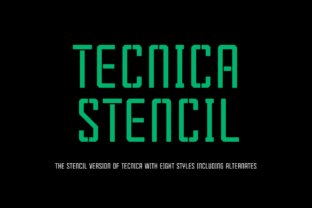
The Tecnica Stencil Family is the stencil version of the original Tecnica typeface family. Where Tecnica offers a clean, geometric sans-serif design, the stencil variant intentionally introduces gaps and breaks in the letterforms—characteristics that allow the type to be cut out of physical material while maintaining readability. This is not a novelty or a gimmick; it is a functional design that solves a real production problem: how to create legible text when the letters must be punched, cut, etched, or sprayed through a template.
Designed by Pablo Balcells in 2014, the family comprises 8 distinct styles, divided into two main subfamilies:
- Stencil 1 (4 styles): These feature a narrow stem width, optimized for large-size types and printing on rigid materials like metal, wood, or thick plastic. The narrow bridges help maintain structural integrity in the cut-out template while keeping the letters crisp at bigger sizes.
- Stencil 2 (4 styles): These use a wider stem width, designed for small-size types and lightweight or flexible materials such as paper, cardboard, vinyl, or thin plastics. The wider bridges prevent the stencil from tearing or distorting when producing smaller characters.
Each subfamily includes regular and bold weights, with corresponding italic versions, giving designers a solid range of options without overwhelming complexity. This deliberate simplicity is part of what makes the Tecnica Stencil Family so practical: it gives you exactly what you need, nothing more.
Why Stencil Typefaces Are Gaining Attention
Typography trends often follow larger cultural and technological shifts. Over the past decade, we have seen a resurgence of interest in industrial aesthetics, maker culture, and authentic, handcrafted visuals. At the same time, digital fabrication tools—laser cutters, CNC routers, vinyl cutters—have become more accessible to small businesses and individual creators. This convergence has created a growing demand for typefaces that work seamlessly in both digital and physical production workflows.
Stencil fonts, once relegated to shipping crates and military stencils, are now used in branding, packaging, signage, and editorial design to convey a sense of durability, honesty, and utility. The Tecnica Stencil Family fits perfectly into this movement because it was designed from the ground up with those practical requirements in mind—not as a decorative afterthought, but as a functional tool.
Professionals are paying attention to this family specifically because it addresses the tension between aesthetic appeal and physical reality. When you design a stencil font that must be cut out by a machine, every curve and connection has to be carefully engineered. Pablo Balcells solved this by creating two distinct optical sizes (Stencil 1 and Stencil 2) so that whether you are making giant warehouse labels or small product tags, you get optimal legibility and structural soundness.
Changing Workflows and Expectations
The way we produce physical printed matter has evolved dramatically. In the past, stencils were often handmade or produced with limited precision. Today, digital cutting machines can reproduce complex type designs with incredible accuracy—but only if the typeface is built to handle the constraints of the material and the method.
Consider a small manufacturing company that wants to label its products with a rugged, industrial look. If the designer picks a generic stencil font that was not engineered for actual cutting, the bridges between letter segments may be too thin, causing the stencil to break after a few uses. Or the gaps may be too wide, making the letters look disjointed at the required size. The Tecnica Stencil Family eliminates these risks because its two stem width categories were developed based on the physical properties of common materials and production scales.
Similarly, a graphic designer working on a large-format wall mural might choose a Stencil 1 style to ensure the letters remain readable from a distance, while a packaging designer creating small labels could rely on Stencil 2 for crisp, durable results. This kind of thoughtful specialization is exactly what today’s professionals need: they do not want to guess or compromise. They want a proven solution that respects both their creative vision and their production constraints.
Broader Trends: Authenticity and Function-Driven Design
Beyond the technical benefits, the Tecnica Stencil Family aligns with a larger trend toward function-driven design. In an era of fast-paced digital consumption, there is a renewed appreciation for objects and visuals that feel real, tactile, and purposeful. Stencil typography inherently carries this quality: it looks like it has been applied to a surface, not just rendered on a screen.
Businesses and creators are increasingly using stencil fonts to communicate honesty and ruggedness. For example, a craft brewery might use Tecnica Stencil on its cans to evoke the feel of industrial equipment and the hands-on process of brewing. A hardware startup might incorporate it into product packaging to reinforce a message of durability. Even digital interfaces sometimes borrow stencil aesthetics to add a layer of authenticity to virtual products.
Moreover, the sustainability movement is influencing typography choices. When designing for physical production, minimizing waste material is a real concern. A well-engineered stencil font like Tecnica Stencil can reduce the number of cutting attempts needed, save material, and extend the life of the stencil itself. This appeals to environmentally conscious businesses and those looking to reduce operational costs.
Practical Applications Across Industries
The versatility of the Tecnica Stencil Family makes it suitable for a wide range of uses. Here are some practical examples observed in recent projects:
- Industrial signage: Factories and warehouses use Stencil 1 styles for large labels on equipment, pallet racks, and safety signs. The narrow bridges ensure durability even when cut from heavy-duty materials like steel or acrylic.
- Product packaging: Small-batch artisans often choose Stencil 2 for labels on bottles, boxes, and bags. The wider stems hold up well when printed on flexible materials like kraft paper or biodegradable plastics.
- Event visuals: Conference organizers and festival producers use the family for directional signage, stage backdrops, and badges. The clear, geometric letterforms are easy to read at a distance and work well in both indoor and outdoor settings.
- Brand identity: Startups and established companies alike have adopted Tecnica Stencil for its no-nonsense feel. It pairs well with strong colors and clean layouts, giving brands a distinctive, down-to-earth personality.
- Architectural graphics: Wayfinding systems in public spaces benefit from the precision of Stencil 1 when applied to metal or stone surfaces, ensuring long-term legibility without excessive wear on the stencil.
Why Designers Keep Coming Back to Tecnica Stencil
Part of what makes the Tecnica Stencil Family stand out is its balance between geometric uniformity and human readability. Many stencil fonts are either too crude (looking like they were cut with a dull knife) or too refined (losing the characteristic “broken” aesthetic that makes stencils interesting). Tecnica Stencil hits a sweet spot: it is clearly a stencil, but it does not sacrifice typographic grace.
The typeface also benefits from the Graviton Font Foundry reputation for quality and usability. Pablo Balcells, the designer behind both Tecnica and its stencil variant, applied the same systematic thinking that made the original Tecnica a solid workhorse. The stencil version inherits the same consistent proportions and spacing, so designers familiar with Tecnica can transition seamlessly to the stencil variant without needing to rework their layouts.
For professionals who work in both digital and physical mediums, this consistency is a huge time-saver. A brand that uses Tecnica for its website and print materials can easily incorporate the stencil version for packaging, signage, or promotional items without compromising brand recognition. The family works as a cohesive system, not a disconnected collection of fonts.
What This Means for Your Next Project
Whether you are a marketer planning a product launch, a freelancer taking on a signage project, or an entrepreneur looking to refresh your brand, considering the Tecnica Stencil Family can elevate your output—not just aesthetically, but functionally. The key insight is that stencil typography is no longer a niche specialty. As production methods become more accessible and the demand for durable, authentic visuals grows, a well-designed stencil family becomes a strategic asset.
Think about the physical lifecycle of your project: Will the text need to survive outdoor conditions? Will it be produced in large quantities by cutting or printing? Do you need the flexibility to go from large banners to small stickers? If the answer is yes to any of these, then having a typeface like Tecnica Stencil that is engineered for those situations can save you time, reduce waste, and deliver better results.
At the same time, do not overlook the soft benefits: the visual language of stencil fonts communicates transparency, workmanship, and confidence. In a crowded marketplace, these qualities can help your work stand out for the right reasons.
Looking Ahead: Typography That Bridges Digital and Physical
The Tecnica Stencil Family is a reminder that great typography does not just live on screens. As more creators embrace hybrid workflows—designing digitally but producing physically—the need for typefaces that handle both realms gracefully will only increase. Pablo Balcells’ design of Tecnica Stencil, with its two stem-width subfamilies and 8 practical styles, offers a template for how type design can evolve to meet real-world constraints without sacrificing beauty.
For professionals who care about the longevity and performance of their visual communications, investing time in understanding stencil typography is a smart move. And when it comes to finding a stencil family that delivers on its promises, the Tecnica Stencil Family by Graviton Font Foundry remains a reliable, forward-thinking choice—one that respects both the material and the message.