Longway: A Vintage Serif Font for Versatile Branding and Design
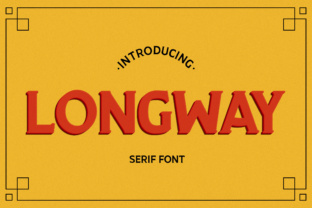
Choosing the right typeface is one of the most impactful decisions a designer or business owner can make. It sets the tone, communicates personality, and even influences how people perceive a product or service. But finding a font that strikes the perfect balance between character and legibility—while working across multiple mediums—can be a genuine challenge. Enter Longway, an all-caps serif font with a distinct vintage touch. Designed to be multifunctional, Longway offers a warm, timeless aesthetic that feels both authentic and modern. Whether you're designing packaging for a small-batch product, crafting apparel graphics, or building a brand identity from scratch, Longway provides a practical solution that helps your message stand out without sacrificing readability.
In this article, we'll explore common design and branding challenges, discuss how Longway addresses them in real-world scenarios, and share actionable tips for making the most of this versatile typeface. Whether you're a seasoned creative or a small business owner handling your own design, you'll find useful insights to elevate your next project.
Why the Right Font Matters More Than You Think
Every design decision communicates something to your audience. The colors you choose, the images you use, and—perhaps most importantly—the fonts you select all work together to create a cohesive impression. A poor font choice can undermine an otherwise excellent design, making it feel amateurish or hard to read. For adults seeking practical solutions, the goal is usually clear: you want to convey professionalism, trustworthiness, and a unique identity without confusing or alienating your audience.
Common challenges include:
- Legibility vs. personality: Many decorative fonts look beautiful at large sizes but become illegible in body copy or on small items like business cards.
- Multilingual needs: If your audience speaks English, Spanish, French, or Portuguese, your font must support all those characters and diacritics consistently.
- Cross-medium performance: A font that looks great on a screen might not print well, and vice versa.
- Brand consistency: Using too many different fonts can fragment your visual identity, while using only one that lacks versatility can feel limiting.
Longway was designed with these very issues in mind. Its serif construction and all-caps format give it a strong, authoritative presence, while the vintage influenced details add warmth and approachability. It remains highly legible at both print and web sizes, and its glyph set covers English, Spanish, French, and Portuguese, making it a reliable choice for diverse audiences.
How Longway Helps You Overcome Design Hurdles
Let's break down some specific situations where Longway shines, and how you can use it to get better outcomes.
1. Packaging That Tells a Story
Product packaging is often the first physical touchpoint a customer has with your brand. Whether it's a bottle of craft spirits, a box of specialty chocolates, or a bag of organic coffee beans, the typography on that package needs to convey quality and craftsmanship quickly. Longway's vintage character is a natural fit for artisan and heritage brands. Its all-caps letterforms create a sense of stability and tradition, while the subtle serifs keep it from feeling too harsh or corporate.
For example, a coffee roaster might use Longway for the brand name on a bag, paired with a clean sans-serif for tasting notes and origin details. The combination feels curated, not chaotic. Because Longway supports multiple languages, the same design can be adapted for Spanish- or French-language markets without having to swap fonts.
2. Apparel That Makes a Statement
Apparel graphics require fonts that are bold enough to stand out on fabric but refined enough to look good as a chest print or back design. Longway's even weight and generous x-height (even in all-caps) mean it reads clearly from a distance. The vintage touch adds a hint of nostalgia that works well for streetwear, retro-inspired lines, or uniform-style branding.
A practical tip: when using Longway on shirts or hoodies, opt for shorter phrases—two to four words—to maintain visual impact. Longway's all-caps structure can feel heavy if used for long sentences, so think of it as a headline font for apparel. Pair it with a simpler script or sans-serif for secondary text.
3. Branding That Feels Both Timeless and Fresh
Building a consistent brand identity often means selecting one primary typeface that can be used across logos, business cards, letterheads, websites, and social media graphics. Longway's versatility makes it a strong candidate for that role. Its vintage leaning gives brands a sense of history and reliability, which is particularly valuable for companies in industries like hospitality, publishing, or premium goods.
For instance, a boutique hotel might use Longway for its logo and main headers, then switch to a clean serif or sans-serif for body text. The contrast is intentional and easy to execute. Because Longway is available in a single weight (all caps), it's important to use size and spacing to create hierarchy—larger for headings, smaller for subheaders or accents.
Practical Applications and Real-World Examples
To help you envision how Longway fits into your own projects, here are a few concrete examples with actionable recommendations.
| Use Case | How to Implement Longway | Expected Outcome |
|---|---|---|
| Product logo (craft soap) | Use Longway for the brand name in all caps, letter-spaced slightly. Add a subtle distressed effect to enhance the vintage feel. | A memorable, artisanal look that stands out on a shelf. |
| Website hero headline | Set the main tagline in Longway at 48px or larger. Use a lighter weight sans-serif for supporting text. | Immediate visual hierarchy that draws the eye. |
| Print ad (poster) | Combine Longway with a background texture like paper or grain. Keep the layout generous with white space. | An elegant, high-quality feel that invites closer reading. |
Different Users, Different Approaches
How you use Longway depends heavily on your role and your goals. Here's a look at three common user types and how they might approach this font.
Small Business Owners
If you're managing your own branding, your primary concern is likely efficiency and impact. You don't have time to test dozens of fonts. Longway simplifies your choice by being one font that works for multiple applications. Use it as your primary display font and pair it with a free sans-serif from Google Fonts for body copy. The result will look cohesive without requiring advanced typography skills. Just remember: because Longway is all caps, avoid using it for long paragraphs—it's best for headlines and short statements.
Professional Graphic Designers
For designers, Longway offers a reliable tool for vintage-inspired projects that need to feel intentional, not gimmicky. Its legibility at small sizes is a distinct advantage when creating packaging or print materials where space is tight. You can experiment with letter spacing, color overlays, and texturing to create unique effects. Because Longway supports four major languages, you can design campaigns that localize easily—saving time and maintaining brand consistency across markets.
Print Shops and Prepress Teams
If you handle production, you know that not all fonts render well in print. Longway's clean serif construction and good stroke contrast make it friendly for offset and digital printing. It also works well in embossing or foil stamping because the all-caps shapes provide enough surface area for the effect to show clearly. For apparel printers, the font's moderate size and even weight help avoid clogging or bleeding on fabric.
Useful Considerations for Getting the Best Results
To make Longway work for you, keep these practical tips in mind:
- Test at multiple sizes: Longway's vintage charm is most apparent at larger sizes (above 24pt), but it remains legible at smaller sizes down to about 14pt for print. On screens, aim for at least 18px for body-style uses.
- Mind your spacing: All-caps fonts can feel dense. Add a bit of letter-spacing (tracking) to improve readability, especially in headlines. A value of 1–3% is often optimal.
- Pair intentionally: Combine Longway with a neutral, clean sans-serif like Montserrat, Open Sans, or Lato for contrast. Avoid pairing it with another bold serif, as that can feel busy.
- Check language support: If your design needs accented characters for Spanish, French, or Portuguese, verify that the specific version of Longway you are using includes them. Most standard retail versions do, but it's always wise to confirm.
- Consider licensing: Ensure you have the proper license for your use case—personal, commercial, or web font. This is especially important for branding and packaging work.
Beyond the Basics: Longway in Digital and Print
Longway was designed to work equally well in print and on the web. For web use, its all-caps structure makes it ideal for hero sections, navigation headers, and call-to-action buttons. Because the font is a serif, it carries a slightly formal, trustworthy tone that can be a nice counterbalance to modern flat design trends. On digital platforms, remember to set appropriate font-display properties to ensure fast loading while maintaining a good user experience.
For print, Longway's vintage character pairs beautifully with off-white or cream paper stocks, textured materials, and foil stamping. It's also a strong choice for magazines and editorial spreads where you need a heading font that commands attention without screaming. Many designers find that Longway works especially well in monochrome or duotone schemes, where the shapes of the letters do the heavy lifting.
Getting Started with Longway
If you're ready to try Longway in your next project, start by identifying one primary use—such as a logo or a product label—and build out from there. Use it consistently for that purpose, and then gradually incorporate it into other brand materials. Because Longway is a single all-caps weight, it's easy to keep your visuals uniform. As you gain experience, you'll discover its nuances: the slight curves in the S, the sturdy serifs on the T and E, the generous bowl of the O. These details add up to a font that feels crafted, not generic.
Don't be afraid to experiment with color, scale, and context. Longway adapts to both refined and rugged environments. A faded letterpress effect can give it a hundred-year-old feel, while a crisp digital rendering lets it sit comfortably alongside modern interfaces. The key is to think of Longway as a tool for storytelling—one that helps your brand speak clearly and memorably.
Ultimately, Longway solves a real problem: finding a single typeface that is legible, characterful, and versatile across languages and media. By using it thoughtfully, you save time, reduce decision fatigue, and create designs that resonate with your audience. Whether you're launching a new product, refreshing an existing brand, or simply looking for reliable typography, Longway deserves a spot in your toolkit.