Merthy: A Handwritten Script Font Built for Real Creative Workflows
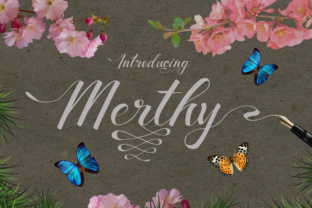
Choosing the right typeface is rarely a casual decision for anyone who works with visual content. Whether you are a small business owner preparing a product label, a freelancer building a brand identity, or an educator designing course materials, the fonts you select directly affect how your audience perceives your message. You need something that looks intentional, reads clearly, and supports the tone you are trying to convey. Merthy, a handwritten script font created by madeDeduk, offers a solution that balances expressive character with practical utility. With over 350 glyphs and a natural flowing style, it is designed to fit into a wide range of projects without forcing you to compromise on readability or consistency.
What Merthy Is and Where It Belongs in Your Process
Merthy is more than a decorative script. It is a full-featured typeface that includes uppercase and lowercase letters, numerals, punctuation, ligatures, alternates, and multilingual support. The handwritten quality gives it a human, approachable feel, but the extensive glyph set ensures you are not limited to a single aesthetic. This makes it suitable for tasks that occur at different stages of a project, whether you are brainstorming initial concepts, refining a final design, or maintaining brand consistency across multiple deliverables.
For example, during the early planning phase of a branding project, Merthy can help you visualize how a casual, personal tone might look on packaging or social media graphics. You can test headlines, taglines, or product names without committing to a final direction. Later, when you move into production, the font's ligatures and alternate characters give you control over how letters connect, helping you avoid awkward spacing or repetitive shapes that can make a script font feel unnatural.
Preparing to Use Merthy: Compatibility and Setup
Before you integrate Merthy into your workflow, it helps to understand how it interacts with your existing tools and assets. The font is available in standard formats such as OTF and TTF, which work across major operating systems and design software including Adobe Creative Suite, Affinity products, Canva, and web platforms that support custom font uploads. This broad compatibility means you can move between applications without reworking your layouts or losing typographic control.
Installation is straightforward. On Windows or macOS, you simply download the font file and place it in your system's font directory. Once installed, Merthy appears in your font menus alongside your other typefaces. If you work in a collaborative environment, you may want to store the font files in a shared asset library or use a font management tool to ensure consistency across team members. This is especially useful if multiple people are producing materials for the same brand or campaign, as it prevents accidental substitutions that could dilute the visual identity.
Understanding the Glyph Set
The 350-plus glyphs in Merthy are not just decorative extras. They serve functional roles that directly affect the quality of your output. Standard ligatures automatically replace problematic letter combinations, such as overlapping strokes in "fi" or "fl," making the text smoother and more professional. Stylistic alternates give you the ability to change the ending of a word, the shape of a capital letter, or the flow of a particular character. This is particularly useful when you need to set a word in all caps but want to maintain a handwritten feel without losing legibility.
If you are designing a logo, for instance, you can experiment with different alternate versions of the same letter to find the combination that best fits your layout. This kind of flexibility reduces the time you spend manually adjusting vector paths or sourcing additional glyphs from other fonts. It keeps your process efficient while giving you a higher degree of polish.
Practical Use Cases Across Different Workflows
Merthy is not a one-size-fits-all tool, but its design lends itself to several common scenarios. Understanding where it fits best helps you make informed decisions about when to use it and when to choose something else.
Branding and Identity Projects
For small business owners and entrepreneurs, a handwritten script can communicate approachability and craftsmanship. Merthy works well for logos, business cards, and packaging, especially when combined with a clean sans-serif or serif font for body text. The alternates and ligatures let you create a unique wordmark that does not look generic. You can also maintain consistency across touchpoints by using the same font for headers on your website, product tags, and email headers.
Social Media and Content Marketing
Marketers and content creators often need to produce visual assets quickly. Merthy can be used for quote graphics, Instagram stories, YouTube thumbnails, and blog headers. Its legible script style works at larger sizes, which is important for mobile-first platforms where text needs to be readable at a glance. Because the font includes numerals and punctuation, you can also use it for promotional codes, dates, or short data points within your graphics without switching to a different typeface.
Educational and Instructional Materials
Educators and course creators often struggle to make their materials feel engaging without sacrificing clarity. Merthy can be used for titles, section headings, or callout boxes in worksheets, slide decks, and handouts. The handwritten quality adds a personal, less formal tone that can help learners feel more connected to the content. However, it is best used sparingly in these contexts, such as for emphasis rather than for long paragraphs, where a simpler font would improve readability.
Product Labeling and Small Print Runs
If you produce physical goods such as candles, skincare products, or food items, Merthy can be applied to labels and tags. The glyph variety helps you avoid the repetition that sometimes makes script fonts look mechanical on small-scale packaging. Because the font supports multiple languages, you can also expand your product line to different markets without redesigning your labels from scratch.
Integrating Merthy with Other Tools and Assets
No font exists in isolation. How well Merthy works in your overall system depends on how you pair it with other elements. For layout and composition, consider combining it with a neutral sans-serif such as Open Sans or Lato for body text. This creates a clear hierarchy where Merthy draws attention to headlines or key messages while the secondary font handles the reading experience.
In terms of color and texture, Merthy's natural line variation works well on both light and dark backgrounds, but you may need to adjust weight or spacing depending on the application. In print, test the font at actual production size to ensure the strokes do not become too thin or too thick. On screen, check how it renders at different resolutions, especially if your audience views content on varied devices.
Managing Consistency Across Deliverables
If you use Merthy across multiple projects or over a long period, develop a simple style guide that documents which alternates or ligatures you prefer, what minimum size the font should be used at, and how it should be paired with other typefaces. This guide saves time when onboarding new team members or when revisiting a project months later. It also protects against drift, where the same font is used in slightly different ways across materials, gradually weakening the visual identity.
Quality Control and Testing
Before finalizing any piece of work that uses Merthy, take a few minutes to check for spacing issues, awkward letter combinations, or unintended alternate characters. Some design applications allow you to toggle stylistic sets on and off, so you can compare versions and choose the most readable option. For long-term use, periodically revisit your font files to ensure they have not been corrupted or replaced during software updates. This is a simple step, but it prevents last-minute disruptions when you are under deadline.
Long-Term Considerations for Using Merthy
Fonts are assets, and like any asset, they require some forethought to deliver consistent value over time. Merthy is well-suited for both short-term campaigns and ongoing brand use because its design is not tied to a passing trend. The handwritten script style has a timeless quality that works for a wide range of industries, from creative services to lifestyle products to education.
If you purchase Merthy through a reputable foundry or marketplace, check the license terms to understand how you can use it across different projects and platforms. Some licenses cover commercial use for a single user, while others allow for broader distribution within a team or organization. Knowing this upfront prevents legal issues later and helps you budget appropriately for future projects.
Building a Personal or Professional Library
Over time, you will likely accumulate a collection of fonts that you rely on regularly. Merthy can become a core part of that library, especially if you frequently produce content that benefits from a handwritten aesthetic. To keep your library organized, group fonts by style, usage context, or project type. This makes it easier to locate Merthy when you need it and to remember which alternate characters or pairings worked well in previous work.
Adapting as Your Needs Evolve
As your projects grow or shift, the way you use Merthy may change. A blogger who initially uses the font for social media graphics might later need it for a book cover or a product line. Because Merthy includes a comprehensive glyph set and supports multiple languages, you can adapt it to new contexts without learning a new typeface. This continuity reduces the friction of scaling your work and lets you maintain a consistent voice across different formats.
The same principles apply if you collaborate with designers, printers, or developers. Providing them with clear instructions about how to use Merthy, including which stylistic sets to enable and which sizes to avoid, ensures that the final output matches your intent. This kind of preparation is especially important when you are not the person executing the final production, as it minimizes back-and-forth revisions and keeps your timeline on track.
Final Observations on Practical Implementation
Merthy is not a font that requires a steep learning curve or special technical knowledge to use effectively. Its value comes from the combination of a natural handwritten aesthetic and a robust set of functional glyphs that give you real control over your typography. Whether you are preparing a brand identity, producing content for social media, designing educational materials, or labeling physical products, the font supports the practical needs of your workflow without adding unnecessary complexity.
What matters most is how you integrate it into your broader process. By thinking ahead about compatibility, establishing consistent usage guidelines, and testing your outputs at the appropriate stages, you can make Merthy a reliable part of your creative toolkit. It is a typeface that respects your time and your standards, which is exactly what you need when you are balancing multiple priorities across different projects.
If you have not yet explored what a script font with over 350 glyphs can do for your work, Merthy offers a clear starting point. It is designed for people who value both aesthetics and efficiency, and it holds up well in the real-world conditions where most content is actually produced. Consider trying it on a single project first to see how it fits your existing process, then expand its use as you discover the scenarios where it makes the most difference.