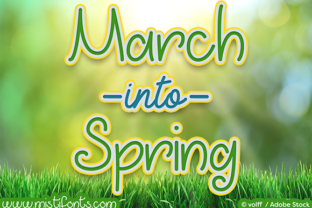
March into Spring: A Handwritten Font Worth Adding to Your Creative Toolkit
If you have spent any time browsing font libraries for a project that needs a personal, approachable feel, you have likely come across March into Spring. This cute, handwritten font has gained a steady following among designers, small business owners, and hobbyists who want their text to feel warm and handcrafted rather than mechanical. And for good reason—its playful letterforms and natural flow can add a layer of sincerity that many standard typefaces simply cannot replicate.
But here is the thing: even a charming font like March into Spring can produce disappointing results if it is chosen or used without care. The difference between a design that feels intentionally lovely and one that looks accidentally messy often comes down to a handful of decisions made before you ever hit the download button. Let us walk through the most common missteps people make with handwritten fonts, with March into Spring as our example, so you can avoid the frustration and get the best possible outcome from your next project.
Mistake Number One: Using a Handwritten Font for Everything
March into Spring is delightful, no question. Its rounded letters and gentle slant give it a friendly, almost whimsical character. That same charm, however, can become a liability when it is applied to every piece of text in a design. I have seen business cards, flyers, and even entire websites set entirely in March into Spring, and the result is almost always harder to read than intended.
The mistake here is treating a decorative font as a workhorse. Handwritten typefaces are designed to evoke personality, not to carry long paragraphs or dense information. When you use March into Spring for body copy, your readers have to work harder to parse each word. The uneven stroke widths and casual letter connections that make it beautiful in headlines can slow down reading speed significantly in blocks of text.
A better approach: Reserve March into Spring for short, meaningful text—headlines, subheadings, pull quotes, product names, or call-to-action phrases. Pair it with a clean, neutral sans-serif or serif font for longer passages. For example, use March into Spring for your main banner headline and a simple font like Open Sans or Lato for the supporting copy. This gives you the personality you want without sacrificing readability.
Mistake Number Two: Ignoring Font Pairing Principles
Even when people do limit a handwritten font to headings, they often pair it with a second typeface that clashes instead of complements. March into Spring has a specific mood—cute, casual, slightly playful. Pairing it with an overly formal serif or a stark geometric sans-serif can create a visual conflict that undermines the whole design.
I have seen a spring sale flyer where March into Spring was used alongside a heavy, condensed sans-serif with sharp angles. The two fonts seemed to belong to different projects altogether. The result felt disjointed, and the intended warmth of the handwritten font was lost.
What works better: Look for fonts that share some underlying quality with March into Spring. A soft, rounded sans-serif like Nunito or Poppins can echo the friendly curves of the handwritten letters. A lightweight serif with gentle transitions, such as Cormorant Garamond, can also work because it does not compete for attention. The goal is contrast without conflict—let March into Spring be the expressive element while the partner font provides structure and stability.
Mistake Number Three: Overlooking Readability at Different Sizes
March into Spring is a handwritten font, and like most fonts in this category, it was drawn with a particular size range in mind. Use it too small, and the fine details—the slight loops, the varying stroke widths, the loose connections between letters—can become muddled. What looked charming at 48 points can become illegible at 12 points.
This is a mistake I see often in social media graphics and product labels. The designer sets a beautiful headline in March into Spring, then uses the same font at a much smaller size for important details like ingredients, dates, or disclaimers. The smaller text becomes a blur of uneven strokes, and the reader has to squint or guess what it says.
Practical advice: Establish a minimum size for March into Spring before you start designing. For print projects, I recommend no smaller than 14 to 16 points. For digital use, aim for at least 18 to 20 pixels. If you need to include small text, use your complementary font for that role. Test your design at actual output size before finalizing—zoom in on screen or print a sample to confirm the handwritten text remains clear.
Mistake Number Four: Downloading from Unverified Sources
Handwritten fonts like March into Spring are widely available, and that popularity makes them a target for unauthorized redistribution. I have encountered people who downloaded March into Spring from a free font aggregator, only to discover later that the file contained malware, missing characters, or incorrect licensing terms. Some versions were even modified without permission, resulting in broken letter spacing or distorted glyphs.
This mistake costs time and sometimes money. A corrupted font file can crash your design software, produce unexpected characters, or fail to render correctly across different devices. Worse, using an unlicensed version can create legal complications if you are designing for a client or selling products that include the font.
How to avoid this: Always purchase or download March into Spring directly from the official foundry, a reputable marketplace like Creative Market, Font Bundles, or Design Cuts, or the original designer’s website. Check the license carefully before you buy. Standard licenses typically cover personal use and small business projects, but if you plan to use the font in a logo, on merchandise, or in a commercial product, you may need an extended license. A few extra minutes verifying the source and license now can save you from a much bigger headache later.
Mistake Number Five: Applying Too Many Effects
Handwritten fonts already carry visual interest. March into Spring has its own texture, rhythm, and imperfections that make it feel authentic. Adding heavy drop shadows, thick outlines, gradients, or elaborate 3D effects often works against that natural appeal rather than enhancing it.
I have seen a logo where March into Spring was given a deep bevel and emboss effect, and the result looked clunky and artificial. The handwritten charm was buried under the digital processing. The same thing happens when people add heavy strokes or dramatic shadows—they inadvertently flatten the very qualities that made them choose the font in the first place.
A lighter touch works better: Let March into Spring carry the visual weight on its own. If you need to add depth, consider a subtle shadow offset just slightly behind the text, or a gentle color overlay that still allows the letterforms to breathe. Keep effects minimal and purpose-driven. When in doubt, test the design with and without the effect—ask yourself whether the effect improves clarity or adds to the message, or if it is just decoration that distracts.
Mistake Number Six: Forgetting the Audience and Context
March into Spring has a specific personality. It is cute, friendly, and casual. That makes it ideal for certain projects and completely wrong for others. I have seen this font used on legal documents, medical brochures, and corporate annual reports, and in every case it undermined the professionalism the document needed to convey.
The mistake is choosing a font based solely on personal preference rather than considering the reader’s expectations. A handwritten font signals informality, approachability, and a personal touch. If your audience expects authority, precision, or seriousness, March into Spring will send the wrong message, no matter how beautifully it is rendered.
Better practice: Before you select March into Spring, define the tone you need to communicate. Is the project personal or playful? Are you addressing children, creatives, or consumers looking for a friendly experience? If yes, March into Spring is an excellent choice. Are you writing to lawyers, executives, or medical professionals about a serious topic? Choose a neutral serif or professional sans-serif instead. Matching font personality to audience expectation is one of the most important design decisions you will make.
What to Check Before You Commit
Before you finalize March into Spring for your next project, run through this quick checklist:
- License: Do you have the right license for your specific use case—personal, commercial, or merchandise?
- Character set: Does the version you downloaded include all the letters, numbers, and punctuation you need, including accented characters if you work in multiple languages?
- Readability at size: Have you tested the font at the actual output size in your layout?
- Font pairing: Have you chosen a complementary font for body text or supporting elements?
- Audience fit: Does the tone of March into Spring match the expectations of your readers?
- File integrity: Did you download from a trusted source, and is the file free of errors?
Taking ten minutes to verify these points can prevent hours of rework and ensure that the charm of March into Spring works for you, not against you.
Final Thoughts on Working with March into Spring
March into Spring is a genuinely useful font when it is used with intention. Its handwritten character can bring warmth to invitations, product packaging, social media graphics, blog headers, children’s materials, and small business branding. The key is respecting what it is—a decorative, personality-driven typeface that shines in small, meaningful doses.
Avoid the common traps of overuse, poor pairing, size neglect, unverified downloads, excessive effects, and mismatched context. Each of these mistakes is easy to make and equally easy to avoid with a little forethought. By treating March into Spring as a deliberate design element rather than a default choice, you will create work that feels polished, professional, and genuinely engaging.
The best designers do not just pick a font because it is cute. They understand what that font does well, where it struggles, and how to set it up for success. With March into Spring, success usually means using it sparingly, pairing it thoughtfully, and letting its natural charm speak for itself. That is how you get the most out of this lovely handwritten font—and how your projects will stand out for all the right reasons.