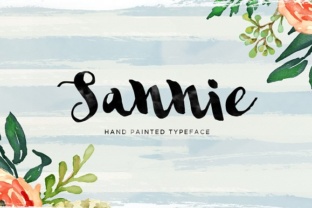
Sannie: A Handwritten Font Worth Evaluating for Your Next Design Project
When you browse font libraries, handwritten typefaces often blur together. Many promise warmth and personality but end up feeling generic or mechanically repetitive. Sannie, a handwritten font created by Area Type, stands apart in a crowded field. It is not just another cursive option—it carries a deliberate looseness and subtle irregularity that makes it feel genuinely hand-drawn rather than digitally perfected. Whether you are a designer choosing type for a branding project, a small business owner refining your visual identity, or a content creator looking for a distinctive voice, understanding what Sannie offers can help you decide if it fits your needs.
What Makes Sannie Distinct
Sannie is a handwritten font that leans into imperfection. Unlike many script fonts that smooth every curve into predictable uniformity, Sannie preserves the natural variation you would expect from real pen on paper. The letterforms are not perfectly aligned, the stroke weights shift slightly, and the overall rhythm feels organic rather than mechanically consistent. This is intentional. Area Type designed Sannie to capture the immediacy of handwriting without sacrificing legibility.
The font includes a full set of uppercase and lowercase characters, numerals, punctuation, and basic ligatures. It works well at display sizes where its textured quality can shine, but it also remains readable at smaller sizes when used sparingly. The weight falls somewhere between light and medium—neither too thin to disappear nor too bold to feel delicate. That balance makes Sannie versatile for headings, short paragraphs, quotes, and accent text.
What really sets Sannie apart from many handwritten fonts is its emotional tone. It feels approachable, slightly whimsical, but not childish. It can convey warmth without becoming overly casual, and it carries a handmade quality that digital-native audiences often respond to positively. This makes it a strong candidate for projects where you want to signal authenticity, creativity, or a personal touch.
How Sannie Compares with Other Handwritten Options
Not all handwritten fonts serve the same purpose. Some are designed for high-speed reading and prioritize consistency. Others lean so far into irregularity that they become difficult to read. Sannie sits in a practical middle zone. Compared to more polished script fonts that look like calligraphy, Sannie feels looser and more spontaneous. It does not pretend to be formal. Compared to highly erratic, rough-edged handwriting fonts, Sannie stays legible and controlled. It gives you personality without forcing the reader to work hard to decode it.
One common tradeoff with handwritten fonts is that they often lack certain typographic features that professional projects require. Sannie includes basic ligatures, which help avoid awkward letter combinations that can break the flow of handwriting. It does not, however, include extensive alternate characters or stylistic sets that some premium script fonts offer. If your project depends on having multiple variations of the same letter to create a truly handcrafted look, you may find Sannie limited in that regard. For most use cases, however, the standard character set is sufficient.
Another point of comparison is versatility. Many handwritten fonts work well only at large sizes. Sannie holds up reasonably well at medium sizes, especially in short bursts of text. For body copy or long paragraphs, a more neutral typeface would likely serve better. But for pull quotes, subheadings, or brief messages, Sannie performs admirably.
Strengths and Limitations to Consider
Every typeface comes with strengths and weaknesses. Understanding them helps you avoid mismatches between the font and the project.
Strengths of Sannie:
- Authentic handwriting feel: The irregularity is genuine, not artificially randomized. It looks like someone actually wrote it.
- Good legibility for a handwritten font: Letterforms are distinct enough that readers rarely confuse characters.
- Friendly but professional tone: It works for both creative brands and more serious projects that need a human touch.
- Solid at display and medium sizes: Whether on a poster or a website banner, it holds its character.
- Clean installation and easy use: Works across major operating systems and design software without issues.
Limitations of Sannie:
- Limited stylistic variations: No swashes, multiple weights, or extensive alternate glyphs. If you need that breadth, you may need to supplement with another font.
- Not ideal for long-form text: While legible, extended reading in a handwritten font can tire the eye. Sannie is best used in small doses.
- Moderate character set: It covers standard Latin characters well, but if you need extended language support, verify compatibility first.
- Less formal than many script fonts: For high-end luxury branding or formal invitations, a more refined calligraphic option might be a better fit.
When Sannie Is the Right Choice
Sannie works best in projects where you want to communicate authenticity, creativity, or a personal connection. Consider it for:
- Small business branding: Coffee shops, bakeries, boutiques, creative studios, and independent service providers all benefit from a font that feels handmade and approachable.
- Social media graphics: Short quotes, announcements, and promotional posts gain personality without losing clarity.
- Packaging and product labels: Especially for artisanal, organic, or handcrafted products where the visual tone matters.
- Website headers and hero sections: Used sparingly, Sannie can anchor a homepage with warmth and distinction.
- Printed materials: Flyers, postcards, greeting cards, and small posters where a personal touch is appropriate.
- Digital content like newsletters or e-books: For section headings or decorative pull quotes, it adds visual interest.
In each of these contexts, Sannie brings a sense of human presence. It signals to the audience that there is a person behind the message, not just a template. That can be a powerful differentiator in a landscape saturated with polished, impersonal design.
When You May Need Another Option
Sannie is not a universal solution. If your project requires a highly formal or traditional look, a more structured script or serif typeface would serve better. For corporate reports, legal documents, academic work, or luxury branding with exacting standards, Sannie may feel too casual. Similarly, if your design demands multiple weights—light, regular, bold, italic—then Sannie alone cannot meet that need. You would need to pair it with a complementary typeface or choose a family with greater depth.
Another scenario is when you need extensive language support. Sannie covers most Western European languages, but if your audience reads in Cyrillic, Greek, or other scripts, it will not work. Always check the character coverage against your specific requirements.
Finally, if your design relies on ultra-detailed calligraphy with swashes, flourishing ascenders, and decorative alternates, Sannie is not designed for that. It is a handwritten font in the truest sense—simple, direct, and unadorned. If you need ornamentation, look for a dedicated script family with those features.
Practical Considerations for Using Sannie
If you decide to use Sannie, think about how it interacts with the rest of your typographic system. Because it has a strong personality, it works best when paired with a neutral, clean typeface for body text. A simple sans-serif like Open Sans, Lato, or Inter can provide contrast without competing. The combination allows Sannie to take center stage when needed while maintaining readability elsewhere.
Pay attention to spacing. Handwritten fonts often benefit from a little extra tracking or letter-spacing, especially at smaller sizes. Test how Sannie appears in your specific layout rather than assuming default settings will work perfectly. Also consider color and background. Sannie shows well on light backgrounds and can work on darker backgrounds if you choose a contrasting color. Textured or busy backgrounds may reduce legibility, so test those combinations carefully.
Licensing is another factor. Sannie is available through Area Type and various font marketplaces. Check the license terms for your specific use case—commercial use, web embedding, app integration, and print runs all may have different requirements. Understanding this upfront saves time and avoids compliance issues later.
Making an Informed Decision
Choosing a typeface is rarely about finding one that is universally best. It is about matching the font to the message, the audience, and the medium. Sannie offers a genuine handwritten aesthetic that many similar fonts fail to deliver. It balances personality with readability in a way that makes it broadly useful without being generic. For designers and non-designers alike, it provides a reliable option when you need warmth and authenticity without sacrificing professionalism.
If your project calls for a clean, polished script, keep looking. But if you want something that feels real—written by a hand, not a machine—Sannie deserves serious consideration. Test it in your context, compare it with a few alternatives, and see whether its particular flavor of imperfection matches the tone you want to convey. That is the only way to know if it is the right tool for your work.