Filigran: A Decorative Font for Distinctive Design – An Evaluation
When selecting a typeface, the balance between readability and personality often drives the decision. Decorative fonts occupy a unique space: they are rarely the workhorse of a paragraph but can define the visual identity of a project. Among these, Filigran stands out as a decorative font created by Hungarian type designer Eva Barabasne Olasz. Its name hints at filigree metalwork—intricate, delicate, and ornamental. This article evaluates Filigran to help you determine whether it aligns with your design goals, what tradeoffs it brings, and when alternatives might serve you better.
Understanding Filigran
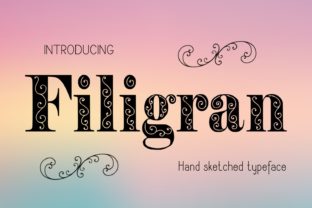
Filigran is a decorative display typeface characterized by ornate letterforms, high contrast between thick and thin strokes, and elaborate swashes or flourishes. Eva Barabasne Olasz designed it with an eye for elegance, drawing inspiration from historical calligraphy and ornamental engraving. The font typically includes a full set of uppercase and lowercase letters, numerals, punctuation, and a range of ligatures and stylistic alternates. It is not a neutral typeface; its personality is immediately apparent. Filigran is intended for headlines, invitations, logos, and any context where the visual form of the text matters as much as the words themselves.
For designers evaluating Filigran, the first consideration is its classification as a decorative or display font. This means it is not optimized for extended reading or small sizes. The fine details that give Filigran its charm can become muddled below 14–18 points, depending on the medium. Understanding this limitation is essential before committing to the font for a project.
Reasons to Consider Filigran
Several qualities make Filigran appealing to designers and brand owners. Visual uniqueness is a primary driver. In a landscape of ubiquitous sans-serifs and safe serifs, a distinctive decorative font can set a project apart. Filigran’s ornate details evoke tradition, craftsmanship, and luxury. It works well for event invitations (weddings, galas, awards ceremonies), certificates, book covers for historical or poetic works, and branding for boutique hotels, wineries, or high-end cosmetics.
Another reason is the emotional tone it conveys. Filigran can suggest formality, romance, nostalgia, or artistry. If your audience expects a refined, handcrafted aesthetic, Filigran may reinforce that perception. Additionally, the designer behind the font—Eva Barabasne Olasz—brings credibility. Her other typefaces often show a strong sense of calligraphic flow, and Filigran is no exception. For those researching decorative fonts, a designer’s portfolio can indicate the quality and usability of a particular release.
Benefits
- High visual impact: Filigran draws attention and can elevate the perceived value of a design piece.
- Rich typographic features: Many versions include alternates, swashes, and ligatures that allow customization and avoid a repetitive look.
- Distinctive brand voice: For projects aiming to communicate elegance, heritage, or artistic flair, Filigran provides an immediate shorthand.
- Print-friendly: The fine lines and details are well-suited for letterpress, foil stamping, or high-resolution offset printing where texture and nuance are appreciated.
Tradeoffs and Considerations
- Limited legibility at small sizes: Thin strokes can disappear in screen rendering or at reduced point sizes. Body text or captions set in Filigran may frustrate readers.
- Not ideal for long-form reading: The ornamental nature slows reading speed and can fatigue the eye. Reserve it for short, impactful text.
- Requires careful pairing: Filigran demands a complementary typeface for secondary text. A neutral sans-serif like Helvetica or a modern serif like Mrs Eaves often works, but testing is crucial.
- Potential for overuse: Using Filigran in too many contexts within a single project can overwhelm the design. Restraint is necessary.
- File size and performance: If the font includes many alternates and swashes, the file may be heavier. For web use, this can affect loading times unless subsetting is applied.
Situations Where Filigran Is a Strong Fit
Filigran excels in applications where the text acts as decoration. Consider it for:
- Formal invitations and stationery: Wedding invitations, save-the-dates, and gala announcements benefit from its ornate elegance.
- Certificates and diplomas: The formal, prestigious feel aligns with official recognition documents.
- Short display headlines: Magazine covers, book titles, or section headers in a publication can use Filigran as a visual anchor.
- Branding for luxury goods: Wineries, perfumeries, and high-end fashion boutiques often seek a typeface that suggests heritage and refinement.
- Artistic or thematic projects: Poetry books, historical fiction covers, or museum exhibition materials can incorporate Filigran to reinforce the aesthetic.
- Logos and wordmarks: When a brand name is short and the desired impression is classic artistry, Filigran can serve as a distinctive logotype.
Situations Where Alternatives May Be Worth Considering
Despite its allure, Filigran is not a universal solution. In the following situations, you may want to look at other options:
- User interfaces and web body text: Legibility at small sizes and on screens with varying resolutions is critical. A clean sans-serif or a well-optimized serif will outperform Filigran for reading comfort.
- Minimalist or modern brand identities: If the brand strategy emphasizes simplicity, clarity, or Scandinavian minimalism, an ornate font like Filigran could contradict the intended message.
- Long-form documents: Reports, articles, blog posts, or books rely on easy readability. Even for chapter headings, an overly decorative font may distract.
- Projects with tight budgets: If you cannot license the font for all required weights or if you need a web version with good hinting, a more common decorative font might be more practical.
- Multilingual or extended character sets: Check whether Filigran supports the languages you need. Some decorative fonts have limited coverage, so alternatives like Alex Brush or Playfair Display may offer broader support.
Practical Decision-Making Insights
To determine whether Filigran is right for your project, follow a structured evaluation process. Start by testing the font at the actual sizes and mediums you will use. Print a sample at 12pt and 24pt on coated and uncoated paper. View it on a high-resolution screen and a standard monitor. Check how the thin strokes hold up in reversed-out type or over a busy background.
Next, pair Filigran with one or two complementary typefaces for body copy or supporting text. A common approach is to use Filigran for headlines and a classic serif like Baskerville or a humanist sans-serif like Frutiger for the body. Evaluate the overall harmony. Does the contrast feel intentional or jarring? Consider the context: a wedding invitation may tolerate more decorative contrast than a corporate brochure.
Also examine the font’s OpenType features. Filigran may provide stylistic sets, contextual alternates, and discretionary ligatures. These can save time in customizing letter pairs but require you to understand how to access them in your design software. If you lack experience with advanced typographic controls, a simpler decorative font might be easier to manage.
Licensing is another practical factor. Confirm whether the version you intend to use covers commercial use, web embedding, or application embedding. Eva Barabasne Olasz’s fonts are often available through foundries like MyFonts or Fontspring, with standard desktop and web licenses. Read the terms carefully, especially if you need to extend usage to multiple clients or large distribution.
Lastly, consider future scalability. Will Filigran remain suitable if your brand expands into new media? A highly decorative font may limit applications—you might need a second, more versatile typeface for e‑commerce or social media templates. Plan for that flexibility upfront.
Conclusion
Filigran by Eva Barabasne Olasz is a decorative font with genuine aesthetic value. It brings elegance and ornamentation to designs that benefit from a handcrafted, formal look. However, its strengths are situation-dependent. For projects where visual impact and refinement are paramount, Filigran can be an excellent choice. For contexts requiring readability, neutrality, or digital performance, alternatives may serve you better. Evaluate your specific audience, medium, and brand identity before making a final decision. With careful testing and pairing, Filigran can become a memorable element in your design toolkit.